

Cedar, Pine, and More: What’s the Best Wood for Fencing?
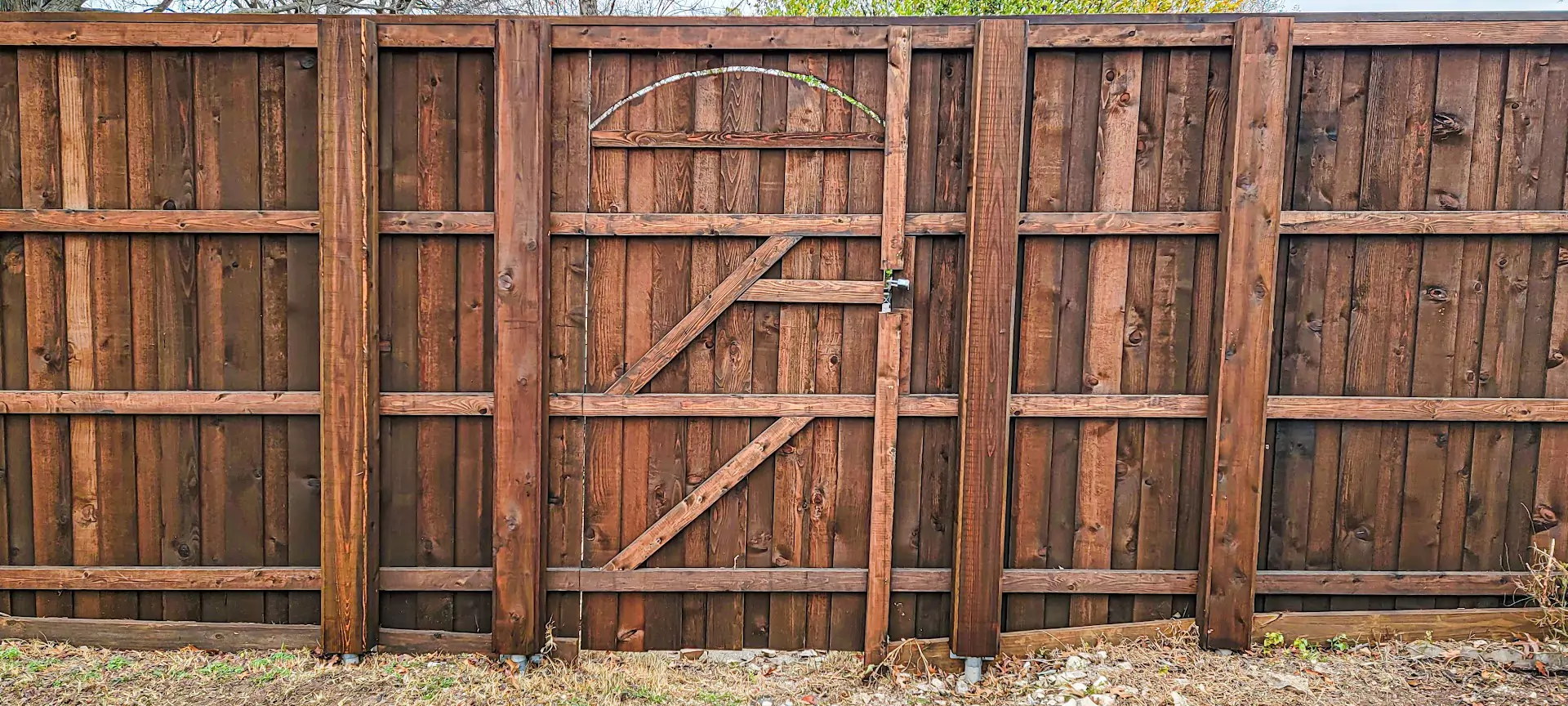
The most common type of wood for fencing in Dallas Fort Worth Texas is going to be either western red cedar, Japanese cedar, or a pine. However, there are many types of wood for fencing, and many types of cedar. Beware of low quality cedar knockoffs and always make sure you’re getting the exact wood you want.
It can be difficult for the untrained eye to distinguish between different types of woods, so make sure you trust the supplier and/or the installer that is providing the wood for you.
Below is a chart going over some of the different types of woods used for fencing, some more common than others.
| Wood type | Scientific name | Color / characteristics | Durability | Notes | Source |
|---|---|---|---|---|---|
| Western Red Cedar | Thuja Plicata | Reddish-brown | Very Durable | MODERATELY COMMON | Pacific Northwest |
| Eastern Red Cedar | Juniperus Virginiana | Unique reddish/purplish-brown color, aromatic, rustic | Very Durable | MODERATELY COMMON | Eastern USA |
| Northern white cedar | Thuja Occidentalis | Light tan to white color, lightweight, fine texture | Durable | COMMON | Northeastern USA/Canada |
| Japanese Cedar (Sugi) | Cryptomeria Japonica | Reddish-brown color, pleasant fragrance | Durable | Most common here – often the cedar that people refer to VERY COMMON | Japan |
| Yakusugi | Cryptomeria Japonica (but from Yakushima) | Dark reddish-brown to brown. Dense, intricate grain patterns | Very Durable | Ancient trees in Japan, VERY RARE | Yakushima island in Japan, protected |
| Tochi Sugi | Cryptomeria Japonica (but from Tochigi) | Reddish-brown | Durable | From Tochigi, Japan LIMITED AVAILABILITY | Tochigi, Japan |
| Chinese cedar | “Chinese Toon” or Toona sinensis | Reddish-brown to yellowish-brown | Ok durability, more like pine | Not a true cedar. Appearance: It has a reddish-brown color and a fine texture, which can be visually similar to Western Red Cedar, leading to confusion among buyers. Sourced from China COMMON | China |
| Atlantic White Cedar | Chamaecyparis thyoides | Light Color | Durable | MODERATELY COMMON | Eastern USA |
| Port Orford Cedar | Chamaecyparis Lawsoniana | Light yellow to white, aromatic, strong | Very Durable | LIMITED AVAILABILITY | Western USA (Oregon) |
| Untreated Pine | Pinus spp. (various species, including Pinus taeda for Loblolly Pine, Pinus palustris for Longleaf Pine, and Pinus elliottii for Slash Pine) | Light yellow to pale brown | Not Durable | Very available | Southern USA, Primarily southeast USA |
| Treated Pine | Pinus spp. (various species, including Pinus taeda for Loblolly Pine, Pinus palustris for Longleaf Pine, and Pinus elliottii for Slash Pine) | Greenish hue, natural over time | Durable | Very available | Southern USA, Primarily Southeast USA |
| Spruce | Picea spp. (various species, including Picea glauca for White Spruce and Picea mariana for Black Spruce) | White to Pale yellow | Less Durable | Moderately available | Northern USA and Canada |
| Redwood | Sequoia sempervirens | Rich reddish-brown | Very Durable | Rare in Texas, more common in the west | Primarily California |
| Oak | Quercus spp. (various species, including Quercus alba for White Oak and Quercus rubra for Red Oak) | Light to medium brown | Very Durable (may crack) | Rare for fencing materials | Eastern USA |
Other, lesser known cedars: Alaska yellow cedar (from Alaska), Spanish Cedar (from Central and South America), and Lebanon Cedar (from the Lebanon / Turkey regions).
Broad Use of “Cedar”: The term “cedar” is often used broadly in marketing to describe various aromatic and durable woods, even if they do not belong to the true cedar genus (Cedrus).
How Do I Make Sure the Wood I’m Getting Is ACTUALLY the Wood I Want?
Ask for documentation, order from a reputable supplier, get an expert to physically inspect
What Does the Grade of Wood Mean?
The grade number refers to the amount of knots and imperfections in the wood. The lower the number, the less knots and imperfections, with “clear” being the one with the fewest imperfections.
| Grade | Characteristics | Common Use | Cedar Example |
|---|---|---|---|
| Clear | Free of knots and defects, visually clean | High-end applications, decorative fencing, trim | Clear cedar for premium fencing and outdoor projects |
| #1 Grade | Few small, tight knots, mostly defect-free | Visible structural applications, high-quality fencing | #1 grade cedar for visible fencing panels and posts |
| #2 Grade | More and larger knots, minor defects | Structural purposes, general construction, fencing | #2 grade cedar for durable and aesthetically pleasing fencing |
| #3 Grade | Numerous large knots, significant defects | Utility applications, temporary structures, rustic fencing | #3 grade cedar for less visible or rustic fencing |
How Does the Grade Affect Durability?
The lower the number, the fewer knots and defects. The fewer imperfections make the wood structurally stronger. The higher the grade (the lower the number) the more consistent and dense the grain pattern typically is. Also, the more premium-grade wood tends to take stains and other finishes more evenly.
A More Premium Grade Comes With More Durability – But How Much More Durable Is a Better Grade Wood?
Lower grade woods are still quite durable compared to the more premium grades. They can still be a great choice for your fence. In fact, some people prefer the more “rustic” look that the lower grades provide with the knots and imperfections.
A #2 western red cedar wood is a great option, and a more economic one at that, compared to a #1 or clear version of the same wood.
There’s also different thickness when it comes to pickets:
| Thickness | Characteristics | Durability | Common Use |
|---|---|---|---|
| 1/2 Inch | Thinner, lighter, more cost-effective | Less durable | Decorative or lower-cost fencing solutions |
| 5/8 Inch | Standard thickness, balanced cost and strength | Good durability | Residential privacy fences, balanced strength and affordability |
| 3/4 Inch | Thicker and sturdier, more resistant to damage | More durable | Higher-end residential fencing, robust applications |
| 1 Inch+ | Very thick, highly robust, considered boards/planks | Extremely durable | Heavy-duty applications, commercial, security, severe weather regions |
The most common thickness for a picket is ⅝”. Builder grade pickets will typically be thinner at ½” and more premium fences will have ¾” pickets. 1” thick pickets are more rare.
What Type of Rails (Stringers) Should You Use for Your Fence?
Rails, also known as stringers or runners, are used for the framing of the fence. These will often be two by fours (2x4s) or two by threes (2x3s). This measurement (2” x 4”) is the measurement of height and width of the lumber as originally cut before it’s dried and finished (planed). The actual measurement of a 2×4 is 1.5” x 3.5”. You can get what’s called, “True” dimension lumber which is not planed down so it remains its true displayed measurement: 2”x4” (if a 2×4).
On a fence it’s recommended to use at least a nominal 2×4 for the rails. Also, if you want true dimension lumber it will be more costly and it can be hard to get a hold of.
Also, when ordering pickets, oftentimes a picket will be displayed as “thickness(in inches) x width(in inches)x height(in feet)”. A 1x6x6 for example means 1 inch thick by 6 inches wide by 6 foot tall. However, this is most likely a ⅝ inch thick by 5.5 inch wide by 6 foot tall picket.
For some reason us fencers like to be as confusing as possible when it comes to labeling materials. Most pickets come in the thickness of 5/8ths and are usually a width of either 5.5 inches (displayed as 6 inches) or 3.5 inches (displayed as 4 inches). Always make sure to clarify with your supplier or contractor the exact dimensions of the pickets you are getting.
The actual reason for this is that this is again a “nominal” measurement. A 1×6 picket is originally cut to approximately 1 inch by 6 inches wide. Then, when it is planed and dried it can end up being a 5/8th inch by 5.5 inch.
Here’s a little more explanation:
Planing and Drying:
- Process: After the lumber is cut to its nominal size, it is dried to reduce moisture content. This process causes the wood to shrink. Following drying, the wood is planed to smooth out the surface, which further reduces its dimensions.
- Result: The final product is smaller than the nominal size due to these reductions.
Industry Standardization:
- Process: After the lumber is cut to its nominal size, it is dried to reduce moisture content. This process causes the wood to shrink. Following drying, the wood is planed to smooth out the surface, which further reduces its dimensions.
- Result: The final product is smaller than the nominal size due to these reductions.
So in conclusion, here’s what to look into when picking the wood for your fencing:
- Pick your wood type for the pickets and rails. This will typically be a type of cedar or pine, but you may be able to get a spruce, redwood, or oak.
- Pick the grade of wood you desire – the lower the number of lumber the less knots and imperfections there will be.
- Pick the thickness of cuts you want – The thicker the wood the more durable (and costly) it will be.
- Make sure to clarify the exact dimensions of the wood you are getting.